
Roth Conversions. Most People Ask the Wrong Question about Roth Conversions
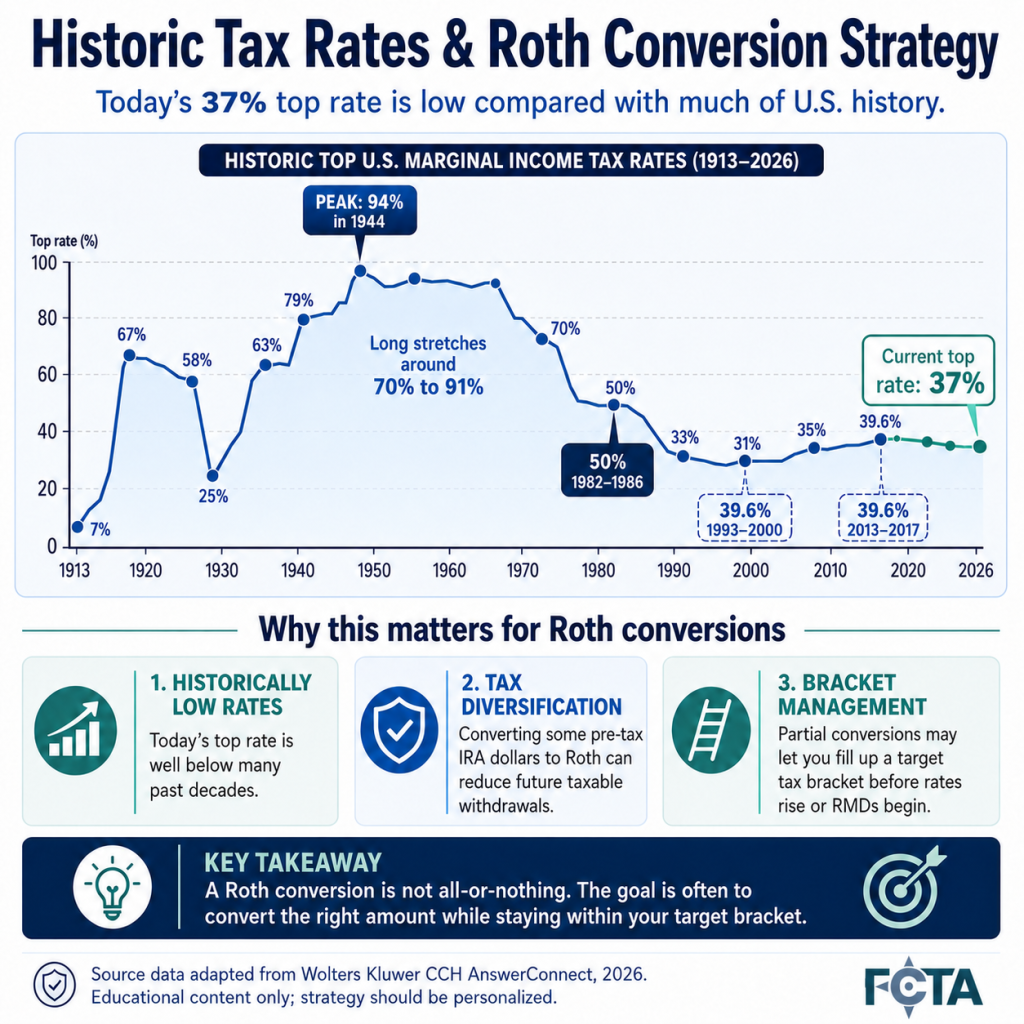
Most people ask the wrong question about Roth conversions. They ask: “Should I do a Roth conversion?” The better question is: “How much should I convert this year?” One of the biggest reasons people avoid Roth conversions is the belief that taxes will be lower later. Maybe. Maybe not. Here’s what we do know: • Federal debt continues to grow.• Annual deficits remain historically large.• Social Security’s trust fund is projected to require legislative action in the next decade.• Medicare costs continue to rise as our population ages.• For most of the last 100 years, the top federal income tax rate has been significantly higher than today’s 37%. None of those facts guarantee higher tax rates. But they do challenge one of the most common assumptions in retirement planning: That waiting will automatically result in paying less tax. A Roth conversion isn’t about predicting Congress. It’s about managing uncertainty. For some families, converting part of a traditional IRA over several years can: ✓ Reduce future Required Minimum Distributions (RMDs) ✓ Create tax-free income later in retirement ✓ Leave heirs more tax-efficient assets ✓ Potentially reduce lifetime taxes through careful bracket management For others, it may not make sense at all. That’s why the answer isn’t found in a headline or a rule of thumb. It’s found in a multi-year tax projection. The most expensive Roth conversion mistake isn’t converting too soon. It’s never running the analysis. How much could you convert this year while staying within your current tax bracket? Many investors have never seen that calculation, email comments to victory@firstcoasttaxadvisor.com First Coast Tax AdvisorClarity. Confidence. Direction. #TaxPlanning #RetirementPlanning #RothConversion #CPA #FinancialPlanning #TaxStrategy #Retirement #WealthManagement
The Midyear Tax Check That Could Save You Thousands
Most people don’t think about taxes until January — by then, most of the year’s opportunities to actually change the outcome are already gone. That’s the problem with waiting. Tax filing season is about reporting what already happened. Tax planning season is happening right now — and it closes faster than most people realize. We work with clients every summer who are surprised to learn how much is still on the table in July that won’t be come December. Here are the areas worth a second look before the window narrows. 1. Check Where You Sit in Your Tax Bracket The One Big Beautiful Bill Act (OBBBA), signed into law July 4, 2025, kept federal income tax rates between 10% and 37% — but where you fall matters more than the rates themselves. What counts for planning purposes is your marginal rate: the rate that applies to your next dollar of income. If you’re sitting close to the edge of a bracket, there’s often still time to manage that — for example, by accelerating certain deductible expenses before year-end. 2026 bracket thresholds (income above the 10% rate): Filing Status 12% 22% 24% 32% 35% 37% Single $12,401 $50,401 $105,701 $201,776 $256,226 $640,601 Head of Household $17,701 $67,451 $105,701 $201,776 $256,226 $640,601 Married Filing Jointly $24,801 $100,801 $211,401 $403,551 $512,451 $768,701 Married Filing Separately Half of joint-filer amounts A quick gut check: has your income moved meaningfully since you last ran these numbers? If yes, it’s worth a closer look now — not in April. One nuance worth knowing: the OBBBA kept the standard deduction high ($16,100 single / $24,150 head of household / $32,200 joint for 2026), which means itemizing only helps if your itemized total clears that bar. The law also reshuffled a few deductions — some got more generous (like state and local tax deductions), others got more limited (like charitable deductions) — and added a few brand-new ones available even if you don’t itemize: deductions for qualified tips, overtime, auto loan interest, and a new “senior” deduction for those 65+. 2. Medical Expenses: Timing Is Everything Medical expenses are only deductible above 7.5% of your adjusted gross income (AGI) — which means when you incur them can matter as much as how much you spend. Deductible expenses can include health insurance premiums, long-term care premiums, medical/dental services, prescription drugs, and even mileage for medical care. (Your health always comes first — this is about timing elective or flexible expenses, not delaying anything medically necessary.) 3. Investment Gains and Losses: A Two-Way Street Long-term capital gains rates weren’t touched by the OBBBA — they remain 0%, 15%, and 20% for investments held over a year. Short-term gains, by contrast, are taxed at your full ordinary-income rate, which can be significantly higher. Long-term capital gains thresholds for 2026 (above the 0% rate): Filing Status 15% Rate Begins 20% Rate Begins Single $49,451 $545,501 Head of Household $66,201 $579,601 Married Filing Jointly $98,901 $613,701 Married Filing Separately Half of joint-filer amounts If you’ve already realized — or expect to realize — significant gains this year, selling underperforming investments to generate offsetting losses is worth exploring. Just keep the wash-sale rule in mind: you’ll need to wait at least 31 days before repurchasing the same or a substantially identical investment. Also worth checking: the 3.8% Net Investment Income Tax (NIIT), which can apply once modified AGI exceeds $200,000 (single/HOH) or $250,000 (joint). There are ways to manage exposure here by adjusting MAGI or net investment income. The Real Question Isn’t “What Deductions Am I Missing?” It’s this: when’s the last time you reviewed your tax strategy — not just your tax return? A bonus, a business distribution, a Roth conversion, an investment sale — these rarely affect just one line of your return. They interact. And by the time everything lands on your 1040 in April, the moment to shape that outcome has already passed. Midyear isn’t just a good time to check in. It’s really the last time. If you’ve read this far, you already know whether this applies to you. Reach out — we’re happy to walk through what a midyear check would look like for your specific situation, no pressure, no obligation.