Most people ask the wrong question about Roth conversions.
They ask:
“Should I do a Roth conversion?”
The better question is:
“How much should I convert this year?”
One of the biggest reasons people avoid Roth conversions is the belief that taxes will be lower later.
Maybe.
Maybe not.
Here’s what we do know:
• Federal debt continues to grow.
• Annual deficits remain historically large.
• Social Security’s trust fund is projected to require legislative action in the next decade.
• Medicare costs continue to rise as our population ages.
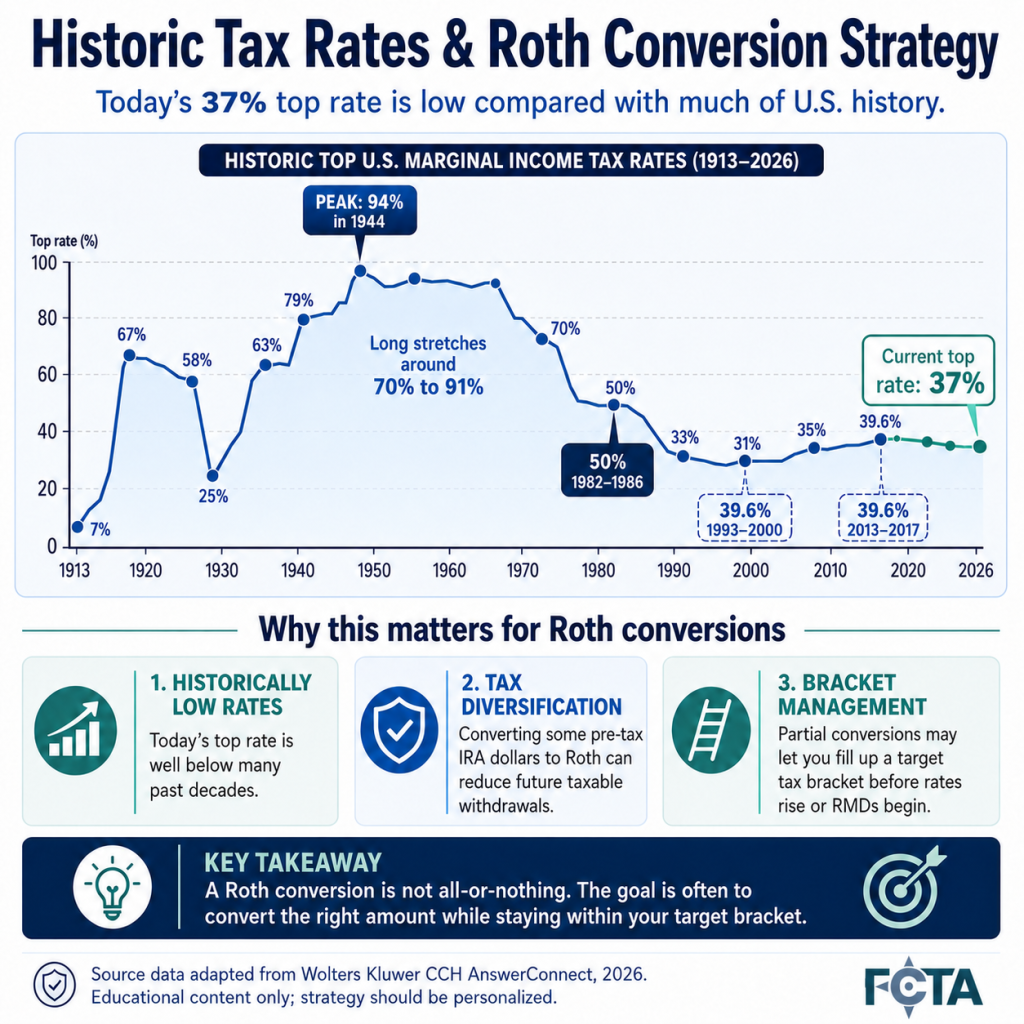
• For most of the last 100 years, the top federal income tax rate has been significantly higher than today’s 37%.
None of those facts guarantee higher tax rates.
But they do challenge one of the most common assumptions in retirement planning:
That waiting will automatically result in paying less tax.
A Roth conversion isn’t about predicting Congress.
It’s about managing uncertainty.
For some families, converting part of a traditional IRA over several years can:
✓ Reduce future Required Minimum Distributions (RMDs)
✓ Create tax-free income later in retirement
✓ Leave heirs more tax-efficient assets
✓ Potentially reduce lifetime taxes through careful bracket management
For others, it may not make sense at all.
That’s why the answer isn’t found in a headline or a rule of thumb.
It’s found in a multi-year tax projection.
The most expensive Roth conversion mistake isn’t converting too soon.
It’s never running the analysis.
How much could you convert this year while staying within your current tax bracket? Many investors have never seen that calculation, email comments to victory@firstcoasttaxadvisor.com
First Coast Tax Advisor
Clarity. Confidence. Direction.
#TaxPlanning #RetirementPlanning #RothConversion #CPA #FinancialPlanning #TaxStrategy #Retirement #WealthManagement