
Roth Conversions. Most People Ask the Wrong Question about Roth Conversions
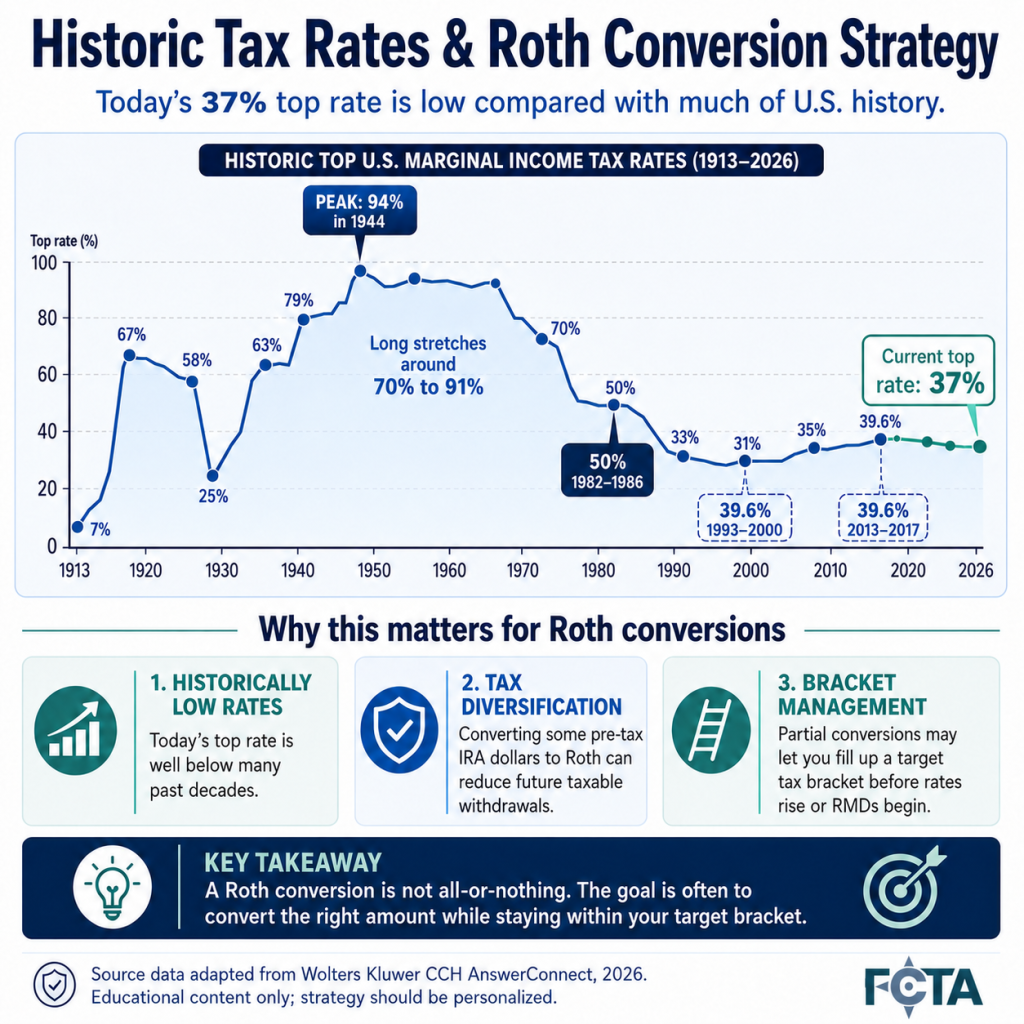
Most people ask the wrong question about Roth conversions. They ask: “Should I do a Roth conversion?” The better question is: “How much should I convert this year?” One of the biggest reasons people avoid Roth conversions is the belief that taxes will be lower later. Maybe. Maybe not. Here’s what we do know: • Federal debt continues to grow.• Annual deficits remain historically large.• Social Security’s trust fund is projected to require legislative action in the next decade.• Medicare costs continue to rise as our population ages.• For most of the last 100 years, the top federal income tax rate has been significantly higher than today’s 37%. None of those facts guarantee higher tax rates. But they do challenge one of the most common assumptions in retirement planning: That waiting will automatically result in paying less tax. A Roth conversion isn’t about predicting Congress. It’s about managing uncertainty. For some families, converting part of a traditional IRA over several years can: ✓ Reduce future Required Minimum Distributions (RMDs) ✓ Create tax-free income later in retirement ✓ Leave heirs more tax-efficient assets ✓ Potentially reduce lifetime taxes through careful bracket management For others, it may not make sense at all. That’s why the answer isn’t found in a headline or a rule of thumb. It’s found in a multi-year tax projection. The most expensive Roth conversion mistake isn’t converting too soon. It’s never running the analysis. How much could you convert this year while staying within your current tax bracket? Many investors have never seen that calculation, email comments to victory@firstcoasttaxadvisor.com First Coast Tax AdvisorClarity. Confidence. Direction. #TaxPlanning #RetirementPlanning #RothConversion #CPA #FinancialPlanning #TaxStrategy #Retirement #WealthManagement
How the new Trump Accounts for children will work

🌊 A New Way to Give Your Child a Financial Head Start: Trump AccountsSometimes Washington actually delivers something worth paying attention to. Buried inside the One Big Beautiful Bill Act (OBBBA) is a new tax-advantaged savings vehicle called a Trump Account (TA) — and for many families, it could become a powerful long-term wealth tool. Even better? For some children, it starts with $1,000 of free money. Let’s break it down. ⚓ What Is a Trump Account?A Trump Account is a tax-deferred savings account designed to help children build long-term financial security. Under a pilot program: U.S. citizen children born between 2025 and 2028 are eligible for a $1,000 federal contributionChildren under age 18 with a Social Security number can also have a TA — just without the government’s $1,000 seedThink of it as planting a financial lighthouse early and letting compounding do the heavy lifting. 🧭 How to Get StartedParents (or guardians) can elect to open a Trump Account by filing Form 4547. Good news: It doesn’t have to be filed with your tax returnAn IRS online portal is expected to open this summer, making setup easierAfter July 3, 2026, parents and even grandparents can contribute up to $5,000 per year (indexed for inflation starting in 2028) until the child turns 18. 👉 The $1,000 government contribution does not count toward this limit. 🌱 More Ways to Fund the AccountTrump Accounts offer flexibility beyond family contributions: Employer ContributionsEmployers may contribute up to $2,500 annuallyContributions are deductible to the employerExcluded from the employee’s taxable incomeCounts toward the $5,000 annual capGovernment & Nonprofit ContributionsState, local, tribal governments and 501(c)(3)s may contribute tax-freeThese don’t count toward the annual limitMust be offered uniformly to qualifying groups 📈 How the Money GrowsContributions aren’t deductible — but growth inside the account is tax-deferred. Until age 18: No distributions allowedInvestments are limited to low-cost, diversified ETFs or mutual fundsNo leverage, no speculation, ultra-low fees (≤0.1%)This isn’t about gambling — it’s about disciplined, long-term growth. 🔄 What Happens at Age 18?When your child turns 18, the Trump Account automatically converts into a traditional IRA. From there: Contributions require earned incomeContributions may become deductibleHigher IRA limits applyDistributions become taxable and may be penalized if taken earlyTranslation: the real power comes from letting the account compound untouched. 🌊 Why This Matters (A Simple Illustration)Imagine this: $1,000 government contribution at birth$5,000 contributed annually for 17 years5% annual growthAt age 18: ~$138,000 Leave it invested until age 65 at the same return: ➡️ Nearly $1.44 million That’s the tide of compounding — and it rewards early action. ⚠️ A Word of CautionTrump Accounts aren’t a one-size-fits-all solution. If education funding is your primary goal, a 529 plan may be a better fit — especially with tax-free education withdrawals and future Roth IRA conversion opportunities. The right strategy depends on your family’s broader financial map. 🧭 First Coast PerspectiveTrump Accounts can be a powerful tool — when used intentionally. The key isn’t just opening the account. It’s aligning it with your tax strategy, cash flow, and long-term goals. If you want help deciding whether a Trump Account — or another tax-advantaged strategy — makes sense for your family or grandchildren, we’re here to help you chart the course. 📍 Clarity. Confidence. Direction.